IC Paper Drafting for Real Estate Investment Decisions
Take an investment from mandate to a populated, stress-tested IC paper drawn from one structured base, so a late change re-renders the draft instead of forcing a rebuild. Quanthome takes an investment from mandate to a populated IC paper: agentic workflows pull holdings, comparables and market context from one structured base into the template the committee expects, and run entry and exit yields, rental growth, capex, gearing and hold period through explicit scenarios. When a number changes late, the change flows through and the draft re-renders, so the committee decides on current data and senior analysts spend their time on judgment rather than assembly.
Decide on one base, on current data.
Read the whole case at once
Holdings, comparables, market context and explicit scenarios arrive in one populated paper drawn from one structured base, so the committee weighs the case instead of reconciling figures from systems that never agreed.
Stop assembling by hand
Holdings and comparables are no longer gathered field by field across many systems and scenarios are no longer bolted on if time allows, so the time once spent on collection moves to judgment.
Re-render, never rebuild
A late valuation, comparable or assumption flows through to the sections it touches and the draft re-renders on current data, so the committee never decides on a paper that was frozen a week earlier.
How investment teams take a deal to the IC paper
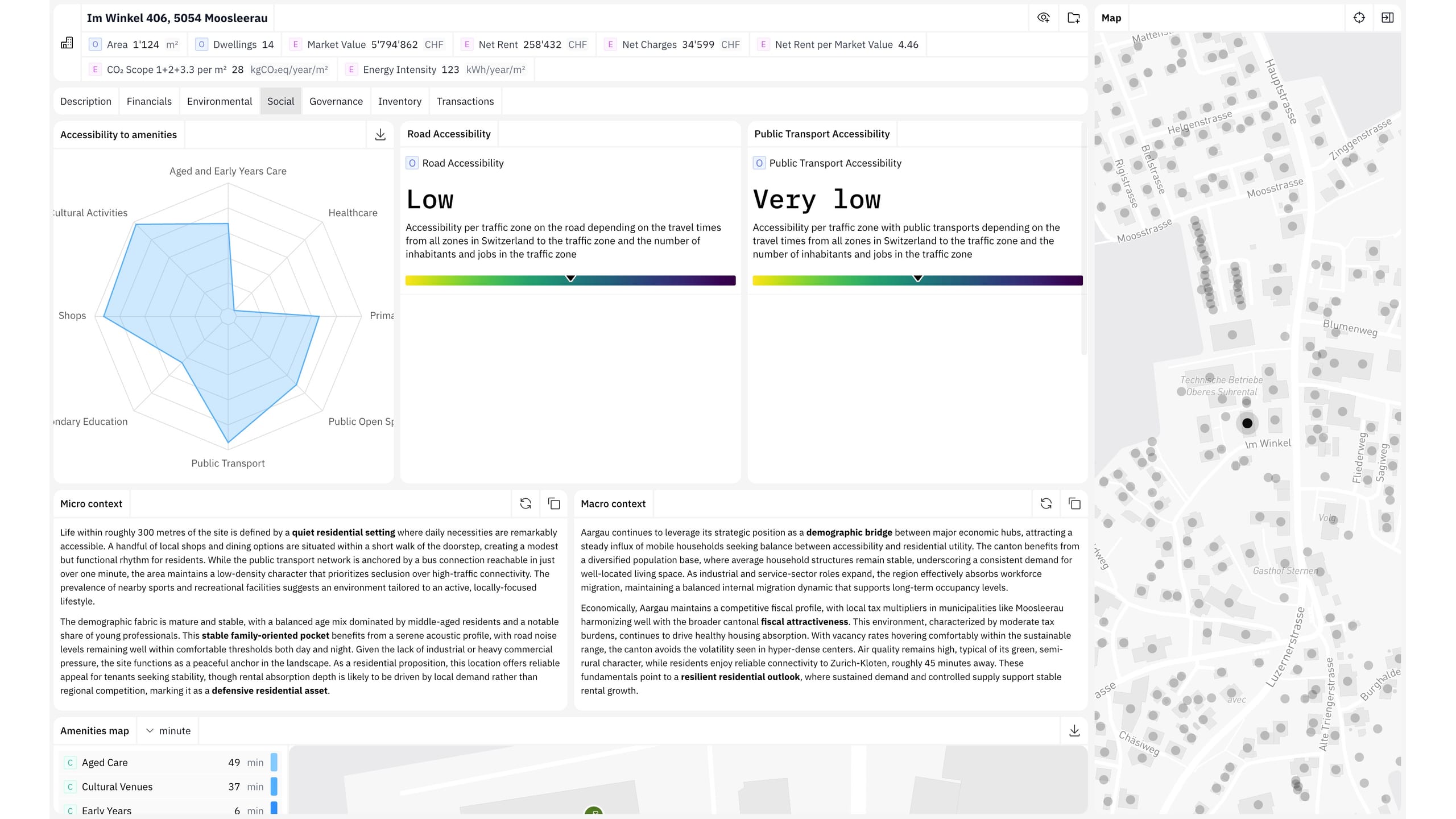
Agentic workflows pull holdings, comparables and market context into the paper from one structured base: the same automated due diligence that feeds a valuation. The paper renders into the template your committee expects. Only the data assembly is automated. Financial, ESG and administrative fields for each asset stand behind the draft; holdings, comparables and context are no longer gathered by hand from many systems.
Run entry and exit yields, rental growth, capex, gearing and hold period through explicit scenarios. The committee sees a range of outcomes rather than a single case with scenarios added by hand if time allows. Comparables come from the same base as peer analysis and indirect investment, so the screen that sourced the deal and the paper that decides it agree.
A late number flows through the paper. The draft is updated, not rebuilt. The committee decides on current data, not on a draft that is already a week old. Senior analysts' time moves from data assembly to the judgment that matters.
Built for
The Swiss real estate desks this job is built for.
Owners & operators
Quanthome gives direct asset owners and the property managers who run their buildings one consistent, building-level view, performance, tenancy, capex and risk, from the same data.
Asset allocators & indirect real estate investors
One view across your direct buildings and your indirect holdings, down to the building, for the reports and decisions your team owns.
Advisors, consultants & brokers
Advise clients on current transaction and market data, not a deck rebuilt by hand. Spend less time producing decks and more on the analysis the client pays for.
See How Quanthome Supports the Investment Decision Workflow
The Building Stock of Swiss Real Estate Investment Vehicles
Retrofitting the Future: The Costs, Timelines, and Strategies Shaping Swiss Real Estate
From mandate to IC paper: where two weeks of senior analyst time actually go
What People Ask Before the First Draft
What is an IC paper?
An IC paper, or investment committee paper, is the document an investment committee reads before deciding on a deal: the mandate, the holdings, market comparables, the assumptions and the stress scenarios behind them. Assembling one typically takes around two weeks of a senior analyst's time, most of it data collection rather than judgment. Quanthome populates the paper from one structured base.
Does this make the investment decision?
No. Quanthome produces a populated, stress-tested IC paper; the decision and the judgment stay with the committee. The point is where senior time goes: when holdings, comparables and scenarios are assembled from one structured base, the time that went into data collection moves to weighing the case, and the committee reads a draft built on current data rather than one already a week old.
What assumptions are stress-tested?
Entry and exit yields, rental growth, capex, gearing and hold period are run through explicit scenarios, so the committee sees a range of outcomes rather than a single case. The scenarios are part of the populated draft rather than added by hand if time allows, and when an input changes late, the scenario set re-renders with the rest of the paper.
Can it match our IC paper format?
Yes. The paper renders into the template your committee expects; only the data assembly is automated. The mandate and the format are fixed first, then agentic workflows populate holdings, comparables and market context into that structure from one maintained base, so the committee reads a familiar document rather than learning a new one.
What happens when a number changes the week of the committee?
The change flows through and the draft re-renders; the paper is updated rather than rebuilt. Because every figure in the IC paper is drawn from one structured base, a late valuation, comparable or assumption propagates to the sections it touches, and the committee decides on a draft that reflects current data instead of one frozen a week earlier.
IC papers re-render when a number changes
Tell us the shortlist and the IC template. We scope the paper with you in a workflow assessment, then produce it for you on current data.
Request a workflow assessment