Dwelling-Level Rent and Value Benchmarking for Asset Management
The problem
Spotting where a portfolio sits below the market means building comparables by hand, listing by listing, then reading the result as a portfolio average that hides the outliers. By the time a below-market rent or a value gap surfaces, a vacancy or a sale has usually already forced the question.
What Quanthome does
Benchmark every building and dwelling you manage against current market quantiles drawn from financial, ESG and administrative fields per asset, rank the rent and value gaps across the portfolio, and read each one against your own mandates and targets. A saved benchmark reopens on current comparables at the next review, so the next reletting or sale starts from the ranked gap rather than a rebuilt market view.
See every gap before the market forces it.
See below the portfolio average
Read each building and dwelling against the current market on rent, value and occupancy, on one maintained base, so the outliers a portfolio average hides surface before a vacancy or a sale exposes them.
Stop hand-building comparables
Market quantiles are maintained on one consistent base of financial, ESG and administrative fields per asset, so no one re-collects listings or re-keys references each review before the rent and value gaps can be ranked.
Refresh, never rebuild
A saved benchmark reopens on current comparables at the next reletting or selling review, moving the time from assembling the market view to acting on the ranked gap.
How asset managers close the rent and value gaps
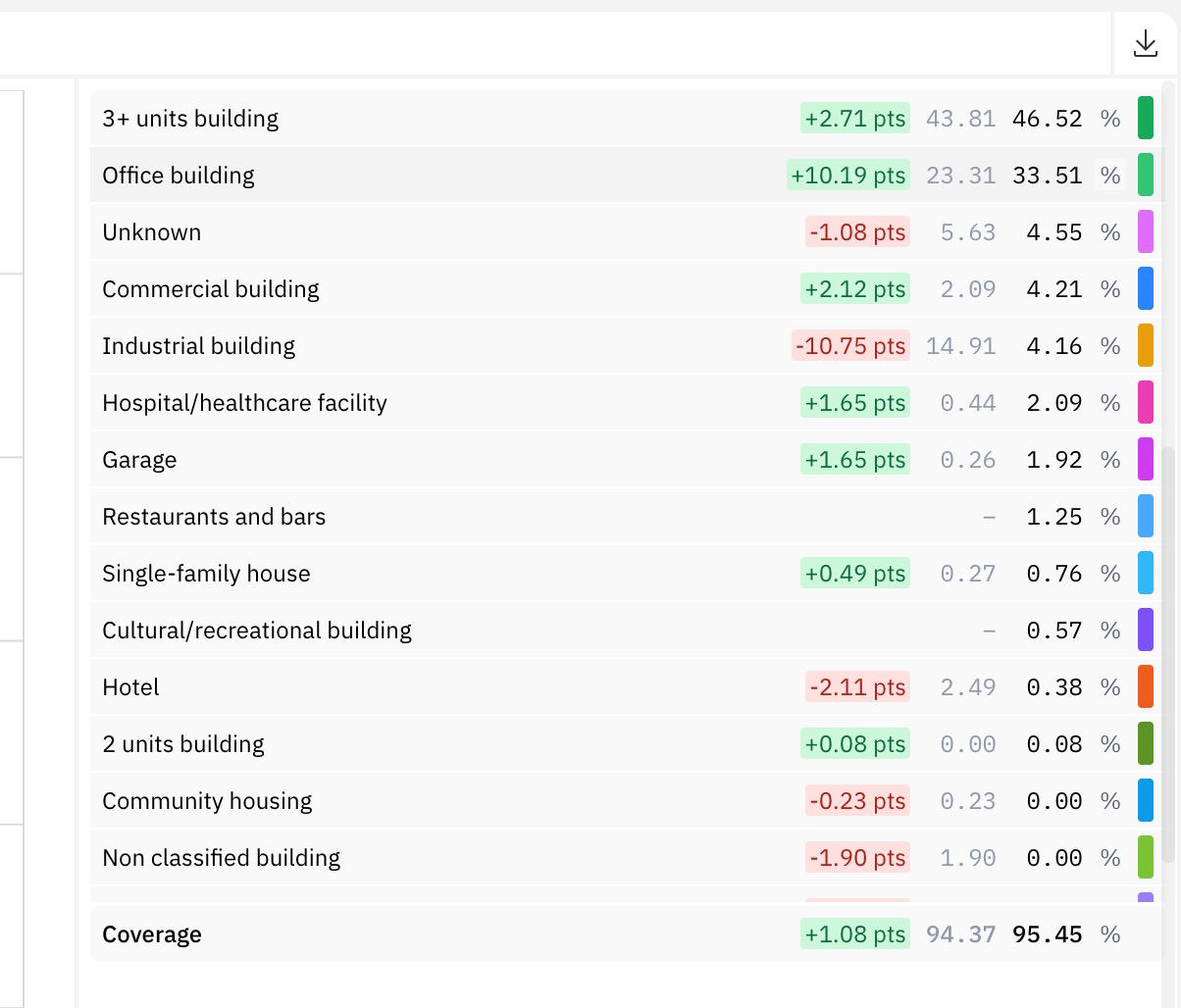
Select the buildings you manage and see how each performs against the market on rent, value and occupancy, not just the portfolio average. Comparables are drawn from deep coverage of the real-estate market with financial, ESG and administrative fields per asset, kept current rather than refreshed only when a deal forces it. Granularity goes down to the individual dwelling, so the outliers a portfolio average hides stay visible.
Each dwelling is compared against its current market quantile to show where rents sit below what the market supports. Below-market rents and value gaps are surfaced and ranked across the portfolio, before a vacancy or a sale forces the question. The Data Engine overlays your own mandates and targets, so the market view is read against the portfolio's constraints rather than a generic average.
A saved benchmark carries its portfolio scope, its market quantiles and its mandate overlay forward. The next reletting or selling review reopens it on current comparables, not last year's reference. Time moves from assembling comparables to acting on the gap.
Built for
The asset management teams that set reletting and sale decisions against where each dwelling actually sits in the market.
Owners & operators
Quanthome gives direct asset owners and the property managers who run their buildings one consistent, building-level view, performance, tenancy, capex and risk, from the same data.
Asset allocators & indirect real estate investors
One view across your direct buildings and your indirect holdings, down to the building, for the reports and decisions your team owns.
Researchers
The full real estate dataset, covering buildings, transactions and vehicles, ready for research and market analysis.
See How Quanthome Supports Asset Management Analysis
Rent gaps in Swiss residential portfolios: what dwelling-level quantiles reveal that averages hide
Setting reletting rents against current market quantiles: a workflow for asset managers
Value gaps before the sale: reading building-level deviations ahead of the valuation round
What People Ask Before the First Benchmark
What is a rent gap?
A rent gap is the difference between a dwelling's contracted rent and the rent the current market supports for comparable units. Quanthome measures it by comparing each dwelling against current market quantiles drawn from deep coverage of the real-estate market, then ranks the gaps across the portfolio, so reletting decisions are set against today's market rather than last year's reference.
How granular is the benchmark?
It goes down to the individual dwelling. Each unit is compared against its own market quantile, not just the building or a regional average, so the outliers a portfolio average hides stay visible. Building and portfolio views aggregate the same data, so the dwelling benchmark and the portfolio number always agree.
Where do the comparables come from?
From Quanthome's coverage of the Swiss real estate market, down to the building and the dwelling, maintained on one consistent base and kept current. Comparables are not refreshed only when a transaction forces it, so reletting and selling decisions are read against today's market rather than against a reference that has aged since the last deal.
Can the benchmark reflect our own mandates and targets?
Yes. The Data Engine overlays your mandates and targets on the market view, so each dwelling and building is read against the portfolio's own constraints rather than a generic average. The overlay is stored with the benchmark and carries forward from one review to the next, so the reading stays consistent over time.
How does a saved benchmark save time at the next review?
A saved benchmark carries its portfolio scope, its market quantiles and its mandate overlay forward. The next reletting or selling review reopens it on current comparables rather than a blank sheet, so the time moves from assembling data to acting on the ranked rent and value gaps.
Every dwelling is benchmarked against its own market before the next review
Tell us the portfolio and the mandate. We will benchmark one of your buildings with you in a working session.
Book a working session